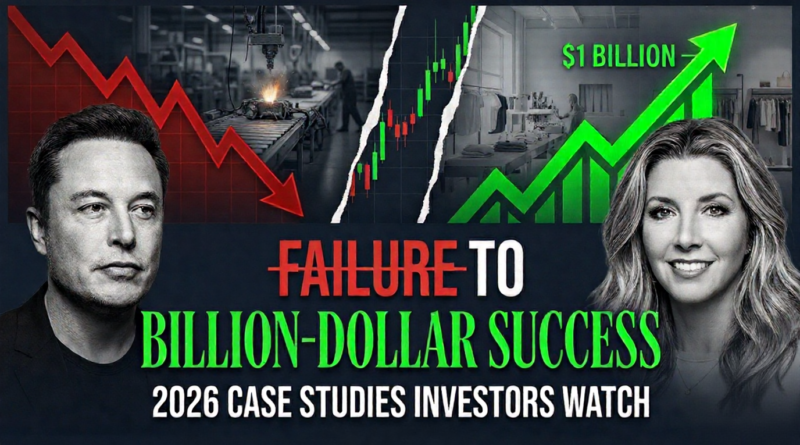
Entrepreneurs Who Turned Failure Into Billion-Dollar Success (2026 Case Studies Investors Are Watching)
Failure used to be something entrepreneurs tried to hide. In 2026, it’s the first thing serious investors look for. That shift didn’t happen randomly. It happened because the market got smarter. Fast growth, unstable economies, and brutal competition exposed one truth: founders who have already failed once are far more dangerous the second time.
So here’s the real question… Why are billion-dollar investors actively backing people who have already failed?
Why Failure Became an Advantage ?
Look at how business worked 10 years ago. You could succeed by getting things “right” early. That doesn’t work anymore. Markets shift too fast. Consumer behavior changes overnight. What works today can break in months.
First-time founders usually build on assumptions. Failed founders don’t have that luxury. They’ve already seen what breaks: products, teams, pricing, and even entire business models. That experience forces a different mindset. Less theory. More precision. And that’s exactly what investors want. Insights from Harvard Business Review’s research on learning from failure reinforce how real-world setbacks improve long-term execution.
Entrepreneurs who turned failure into success
These aren’t motivational stories. These are patterns investors are actively studying.
• Elon Musk
Before becoming the face of innovation, Musk was on the edge of losing everything. SpaceX had multiple rocket failures. Each launch burned millions. Tesla was struggling with production chaos and cash shortages. At one point, both companies were weeks away from collapse. Instead of shutting one down, Musk split his remaining money and pushed both forward. That pressure forced brutal efficiency. Every mistake became a lesson that couldn’t be ignored.
Now Tesla dominates EV markets, and SpaceX leads private space technology. His journey is often referenced in Forbes’ analysis of Elon Musk’s success strategy. Failure didn’t slow him down. It sharpened him.
• Jack Ma
Jack Ma’s story isn’t just about failure; it’s about rejection at every level. Rejected from jobs. Rejected from universities. Even his early business ideas didn’t gain traction. But those failures exposed something most people missed. Small businesses had no easy way to sell globally. That insight became Alibaba Group.
Instead of building another company, Ma built a system that enabled millions of others to grow. His approach is widely discussed in Jack Ma’s business evolution profile. That’s the difference. Failure didn’t just teach him resilience. It showed him where the real opportunity was.
• Brian Chesky
The idea behind Airbnb sounded ridiculous at first. Strangers renting rooms to strangers? Investors didn’t buy it. The company struggled so badly that the founders sold cereal boxes just to stay alive. But the problem wasn’t demand. It was trust. Chesky focused on fixing that, better profiles, better reviews, better user experience. Once trust clicked, growth exploded. Airbnb’s journey is often covered in Entrepreneur’s case study on Airbnb growth.
Today, Airbnb isn’t just a company. It reshaped how people travel.
• Sara Blakely.
She had no investors, no support, and no industry connections. That’s where Blakely started. Manufacturers rejected her product idea. Retailers weren’t interested. Instead of chasing approval, she went directly to customers. She understood exactly what they needed and built around that.
Spanx became a billion-dollar brand not because it was perfect from day one, but because it kept improving based on real feedback. Her story is highlighted in a Forbes profile of Sara Blakely.
• Howard Schultz
Before turning Starbucks into a global brand, Schultz heard “no” more than 200 times from investors. Even after launching, scaling the business wasn’t smooth. The product wasn’t the problem. The experience was great.
Schultz didn’t just sell coffee. He built a consistent environment people wanted to return to. His transformation strategy is detailed in CNBC’s breakdown of Starbucks growth. That shift changed everything.
•Reed Hastings
Before Netflix became a global giant, Hastings failed with his initial business model. It didn’t match how people actually consumed content. Instead of forcing the idea, he pivoted.
Subscription-based streaming wasn’t just a tweak; it was a complete reset based on real behavior. His pivot is analyzed in The New York Times overview of Netflix’s evolution. That decision changed the entertainment industry forever.
What Actually Changes After Failure ?
Failure strips away illusion. Failure forces founders to face reality.It quickly reveals what works, what doesn’t, and what needs to change immediately. Here’s how things usually shift:
| Factor | Before Failure | After Failure |
| Decision-making | Slow, assumption-based | Fast, experience-driven |
| Business model | Complicated, unclear | Simple, scalable |
| Market understanding | Surface-level | Deep and practical |
| Risk handling | Emotional | Strategic |
This is why second-time founders move faster. They’ve already paid the price of being wrong.
Why Investors Are Betting on Failed Founders in 2026 ?
This isn’t a trend. It’s a strategy. According to insights discussed by Harvard Business Review, founders who have failed once are significantly better at navigating uncertainty.
And right now, uncertainty is everywhere. Markets are unstable. Competition is global. Consumer expectations are higher than ever. Investors aren’t just funding ideas anymore. They’re funding execution, and execution improves after failure.
The Real Benefits Most People Miss
Failure only becomes valuable if it changes how you operate. The biggest advantages are practical, not emotional:
However, stopping the chase for ideas that “sound good” shifts focus toward what actually works. So, founders begin building systems designed to scale instead of breaking under pressure. Because of this shift, bad decisions become easier to identify and fix early in the process. This experience also builds a level of resilience that cannot be taught in theory, it only develops through real execution and failure. That combination is rare. And that’s why it attracts serious capital.
Case Study Comparison: What Actually Made Them Win
| Entrepreneur | Initial Failure | Key Shift | Outcome |
| Elon Musk | Financial crisis, failed launches | Operational discipline | Industry dominance |
| Jack Ma | Rejections, failed startups | Global SME focus | E-commerce empire |
| Brian Chesky | Investor rejection | Trust + UX | Market disruption |
| Sara Blakely | Product rejection | Direct customer focus | Billion-dollar brand |
| Howard Schultz | Funding struggles | Experience branding | Global expansion |
| Reed Hastings | Poor market fit | Subscription model | Streaming leadership |
What This Means for You (And Why It Matters)
If you’re building something right now, this changes how you should think.
1- Trying to avoid failure completely is a mistake.
2- The goal isn’t perfection. It’s the speed of learning.
3- The faster you identify what’s not working, the faster you can fix it.
That’s the real edge.
FAQs
Why do most successful entrepreneurs fail first?
Because early ideas are rarely aligned with real market demand. Failure forces alignment.
Do investors actually prefer failed founders?
Yes. They value experience, especially in unpredictable markets.
Is failure necessary for success?
Not always, but it significantly improves decision-making and execution.
What’s the biggest lesson from failed startups?
Market fit matters more than the idea itself.
Can a failed idea become successful later?
Absolutely. Many billion-dollar companies started as failed concepts that were later refined.
Conclusion
Failure hasn’t disappeared from business. It’s just been redefined.
The entrepreneurs leading global markets today aren’t the ones who avoided mistakes. They’re the ones who learned faster, adapted smarter, and rebuilt stronger. That’s why investors in 2026 aren’t asking if you’ve failed. They’re asking what that failure turned you into.
