
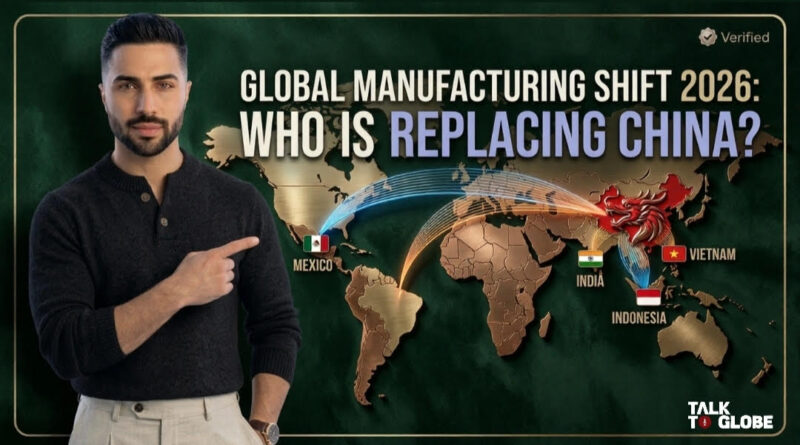
Why Companies Are Leaving China in 2026: Manufacturing Shift
For more than three decades, China was known as the factory of the world. From smartphones and electronics to clothing and machinery, global manufacturing revolved around Chinese supply chains, according to global trade data from the World Bank. But something major is happening in the global economy. Companies across the world are quietly moving their factories away from China and spreading production across some specific countries. This change is known as the global manufacturing shift, and by 2026 it will reshape supply chains, trade routes, and economic power. Understanding this shift is critical for entrepreneurs, investors, and global businesses.
Why Manufacturing Is Leaving China?
China’s manufacturing dominance was built on three key advantages:
. Low labor costs
. Massive industrial infrastructure
. Strong export logistics
But those advantages have changed. Several factors are now pushing companies to diversify manufacturing.
Rising Labor Costs
China’s wages have increased significantly over the last decade. Manufacturing labor that was once extremely cheap is now much closer to global averages. For companies producing low-margin goods, this makes China less attractive.
Supply Chain Risks
Recent global disruptions exposed the danger of relying on a single country for production, a risk highlighted in global economic reports from the International Monetary Fund. Many businesses now follow a strategy called ‘China Plus One’, where companies keep some production in China but move additional factories to other countries.
Geopolitical Tensions
Trade disputes and tariffs between major economies have increased pressure on companies to relocate manufacturing. Businesses want supply chains that are resilient, diversified, and politically stable.
Countries Benefiting From the Manufacturing Shift India
India is becoming one of the most important alternatives to Chinese manufacturing. Major technology companies are expanding production there, especially in electronics and
smartphones.
. Large workforce
. Government manufacturing incentives
. Rapidly improving infrastructure
Vietnam
Vietnam has quietly become one of the fastest-growing manufacturing hubs in Asia. Many global brands now produce products there, especially in electronics, textiles, and consumer
goods.
. Competitive labor costs
. Strong export trade agreements
. Rapid industrial development
Mexico
For companies targeting the North American market, Mexico has become extremely attractive. This strategy is known as nearshoring, where manufacturing moves closer to
consumer markets.
. Proximity to the United States
. Strong manufacturing experience
. Regional trade benefits
Indonesia
Indonesia is emerging as a powerful manufacturing player in Southeast Asia. The country is investing heavily in industrial zones and infrastructure to attract global companies.
. Large population and workforce
. Growing industrial investment
. Strong potential in EV and battery industries
How This Shift Is Changing Global Trade
The manufacturing transition is not just about moving factories. It is reshaping the entire
global economy.
. New supply chain routes
. investment hubs
. New export leaders
What This Means for Businesses
Entrepreneurs and companies need to understand where the next opportunities are emerging. Businesses that adapt early can benefit from:
. Lower production costs
. More resilient supply chains
. Faster access to growing markets
The Future of Global Manufacturing
China will remain an important manufacturing center. However, the world is moving toward a multi-country production system rather than relying on a single manufacturing giant. By 2026 and beyond, the global supply chain will likely include major production hubs across Asia, North America, and emerging markets. Companies that adapt early will be better positioned for the next decade of global trade.
Conclusion
The global manufacturing landscape is entering a new era. Rising costs, geopolitical tensions, and supply chain disruptions are pushing companies to diversify production beyond China. Countries like India, Vietnam, Mexico, and Indonesia are rapidly becoming key manufacturing hubs. For entrepreneurs, investors, and global businesses, understanding this shift is essential for staying competitive in the rapidly changing world economy.
