
Global Trade War 2026: Which Small Countries Are Becoming the Next Manufacturing Giants?
US Tariff War 2026: Which Countries Are Winning and Which Are Losing?
One year ago today, US President Donald Trump stood in the Rose Garden and announced sweeping Liberation Day tariffs on goods from more than 50 countries. The announcement sent shockwaves through global markets and triggered one of the most dramatic trade policy episodes since the Second World War.
Economists warned of recession. Business leaders scrambled to restructure supply chains. And governments around the world braced for impact.
One year later, the picture is far more complex and in many ways, more surprising. Despite tariff rates hitting their highest levels since 1943, global trade did not collapse. In fact, according to McKinsey Global Institute, global trade grew faster than the world economy in 2025. But the winners and losers are not who most people expected.
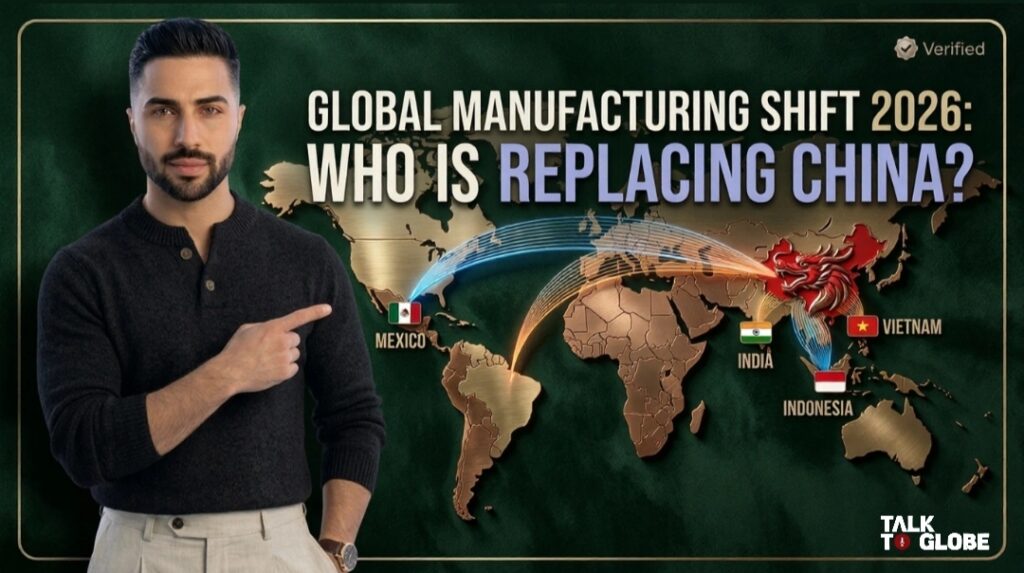
This shift connects directly to the broader global manufacturing shift away from China that was already reshaping supply chains before Liberation Day. The tariffs accelerated everything.
For entrepreneurs, investors, and global businesses, understanding who is winning and who is losing in this trade war is no longer optional. It is the difference between opportunity and exposure.
Why the US Tariff War Happened
The roots of the 2025–2026 trade war go deeper than a single policy decision. Three forces converged to make it inevitable:
- Geopolitical rivalry: The US–China relationship had been deteriorating for nearly a decade, with trade data showing realignment along geopolitical lines well before any tariffs were announced.
- Industrial policy: The US wanted to rebuild domestic manufacturing in critical sectors — semiconductors, steel, electric vehicles, and tariffs were the tool of choice.
- Supply chain vulnerability: The COVID-19 pandemic exposed the danger of over-relying on a single country for critical goods. Governments and corporations were already diversifying before the tariffs pushed the process into overdrive.
What followed was the fastest tariff escalation in modern US history. The average effective US tariff rate rose from 2.6% to over 13% within months, the highest since World War II, according to the Yale Budget Lab. In February 2026, the Supreme Court struck down the IEEPA tariffs as unconstitutional, but Trump responded immediately with new Section 122 tariffs, keeping the trade war alive. Today, the US effective tariff rate stands at 11%, the highest since 1943.
The Clear Winners: Countries That Gained the Most
While headlines focused on the conflict between the US and China, a different story was playing out across Asia, Latin America, and South Asia. Several countries quietly absorbed the trade flows that US–China corridors shed, and they grew rapidly as a result.
🟢 Vietnam and Southeast Asia: The Biggest Beneficiary
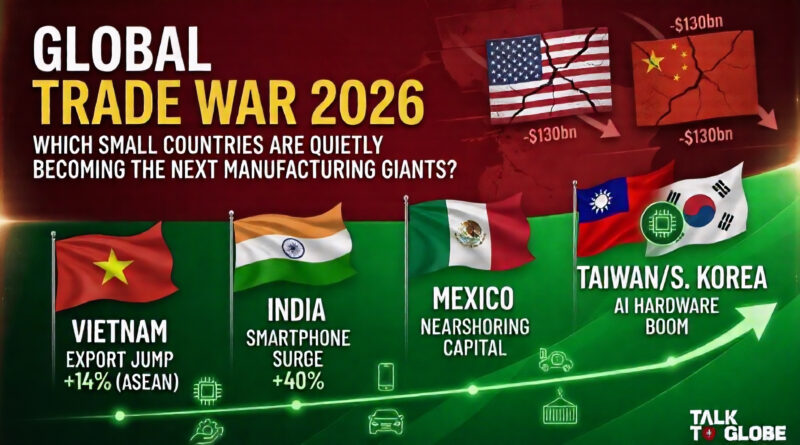
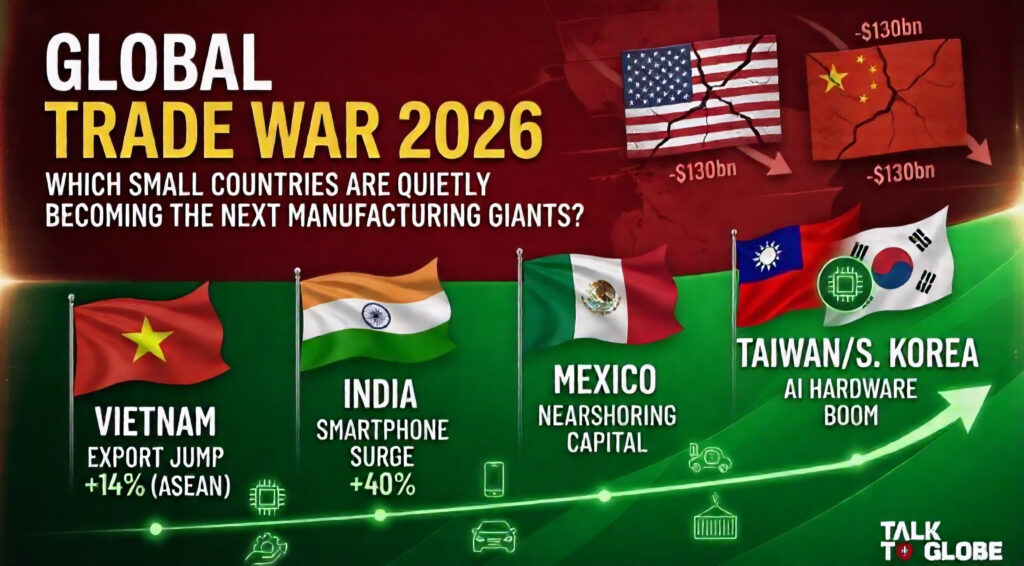
If there is one country that has emerged as the single largest winner of the US tariff war, it is Vietnam. As the US shifted sourcing away from China, ASEAN nations absorbed a massive share of redirected demand. ASEAN exports jumped nearly 14% as Vietnam, Thailand, and Malaysia absorbed supply chains, particularly consumer electronics displaced from China.
Vietnam’s specific advantages made it the dominant recipient:
- Existing manufacturing infrastructure already serving global brands
- Strong trade agreements with the US and EU
- Competitive labor costs compared to China
- Rapid expansion of industrial zones for new factory construction
Major electronics brands that once sourced entirely from China have restructured their supply chains to route production through Vietnam. This is not a temporary fix, it is a structural shift that will define Vietnamese trade for a decade.
🟢 India: The Smartphone Manufacturing Surge
India has emerged as a significant winner in specific high-value sectors, most notably smartphones. The US reduced smartphone sourcing from China by around 40%, dropping imports by $18 billion. India stepped in to capture a large portion of that gap, with smartphone exports surging as major technology companies expanded Indian production.
India’s growing role is supported by:
- Government production-linked incentive schemes attracting major manufacturers
- A large, skilled English-speaking workforce
- Improving logistics and port infrastructure
- Political stability and a growing domestic market
For more on India and Vietnam’s broader rise, see how the countries replacing China in manufacturing are building long-term industrial capacity.
🟢 Mexico: Nearshoring Comes of Age
For companies supplying the North American market, Mexico has become the nearshoring destination of choice. The logic is straightforward: manufacturing closer to the US consumer reduces logistics time, lowers tariff exposure, and keeps supply chains within the USMCA framework.
Mexico’s manufacturing sector has seen significant investment in:
- Automotive components and assembly (Toyota, Honda, and others expanding US production footprint)
- Consumer electronics and home appliances
- Medical devices and pharmaceuticals
🟢 Taiwan and South Korea: The AI Trade Boom
Perhaps the most surprising winner of the tariff war era is the semiconductor and AI hardware supply chain, and Taiwan and South Korea sit at its center. AI-related trade emerged as the single most substantial engine of global trade growth in 2025.
Exports of semiconductors and data-center equipment accounted for one-third of all global trade growth, with Asian hubs supplying markets worldwide, particularly the United States.
This AI trade boom operated largely outside the tariff conflict, as semiconductors and smartphones were exempted from the worst tariff rates. The result: Taiwan and South Korea experienced strong export growth while many other economies struggled.
The Clear Losers: Countries and Economies That Paid the Price
Quick Reference: Winners vs Losers at a Glance
| 🟢 WINNERS | 🔴 LOSERS |
| Vietnam: 14% ASEAN export jump | China: $130bn in US exports lost |
| India: Smartphones +40% to US | EU: Double squeeze, double deficit |
| Mexico: Nearshoring capital of N. America | US Consumers: $780–$1,338 extra per household |
| Taiwan & South Korea: AI hardware boom | Canada: USMCA uncertainty, steel tariffs |
🔴 China: The Biggest Loser in US Trade
The numbers tell the story clearly. US–China trade fell by approximately 30%, with around $130 billion in Chinese exports to the US evaporating from that bilateral corridor. For a country that built its modern economy on export-led growth, this is a significant structural blow to one key relationship.
However, China’s response has been more sophisticated than a simple decline. Chinese exporters have successfully rerouted goods through ASEAN intermediaries, and Chinese total exports actually hit record highs in late 2025 as new markets in the Global South absorbed demand. China is not collapsing, it is pivoting, but its direct trade relationship with the US has fundamentally changed.
🔴 The European Union: Caught in a Double Squeeze
The EU has suffered what analysts at McKinsey describe as a ‘double squeeze.’ On one side, US tariffs have made European goods less competitive in American markets. On the other, a flood of Chinese exports, redirected from the US, has entered European markets at highly competitive prices, pressuring domestic European industries.
EU–China tensions are rising as Europe confronts Chinese overcapacity across sectors: electric vehicles, solar panels, wind components, and semiconductors. The bloc is now considering a new wave of its own trade restrictions, but is hampered by internal political divisions on how aggressively to respond.
🔴 US Consumers: Paying the Hidden Tax
Despite the political promise that tariffs would protect American workers and industry, the data shows that US consumers are bearing a substantial share of the cost. According to the Tax Foundation’s tariff tracker, the current tariff regime represents a loss of $780 to $1,338 per US household per year, depending on whether Section 122 tariffs are extended beyond their July 2026 expiry date.
Higher prices on everyday goods from electronics to clothing to appliances, have been the most direct impact on American families. Companies including Procter & Gamble, Constellation Brands, and Dollar Tree have all flagged significant cost pressures from tariffs.
🔴 Canada: USMCA Uncertainty and Steel Exposure
Canada entered 2026 with significant tariff exposure, particularly in steel, aluminum, and automotive sectors. While most tariffs on Canadian goods have been reduced, a 10% targeted tariff on steel and aluminum products remains permanently in place. The ongoing USMCA renegotiation, the biggest trade negotiation of 2026, adds further uncertainty for Canadian exporters.
The July 2026 Deadline: What Businesses Need to Watch
The current trade war is operating under a ticking clock. The Section 122 tariffs that replaced the struck-down IEEPA measures are set to expire on July 24, 2026. This creates a pivotal decision point:
- If tariffs expire: The US average effective tariff rate falls to approximately 8.2% still the highest since 1946, but lower than current levels. Businesses that front-loaded inventory could see cost relief.
- If tariffs are extended: The rate stays at 11%+, and supply chain restructuring accelerates further. Vietnam, India, and Mexico continue to gain at China’s expense.
- New measures possible: Section 232 tariffs on semiconductors and critical minerals are still under consideration. These could significantly reshape AI hardware trade flows in the second half of 2026.
For global businesses, the message is clear: do not plan around a single tariff scenario. Build supply chains that are resilient to multiple outcomes.
What This Means for Entrepreneurs and Investors
The tariff war has not destroyed opportunity, it has relocated it. For businesses willing to adapt, this is one of the most significant windows for strategic repositioning in a generation. Here is where the smart money is looking:
- Manufacturing investment in Vietnam, India, and Mexico: companies setting up or expanding production in these hubs are locking in cost advantages that will last years
- AI infrastructure and semiconductors: this supply chain is growing regardless of tariff outcomes, and Taiwan, South Korea, and select ASEAN nations are the key nodes
- Logistics and nearshoring services: every company restructuring its supply chain needs warehousing, logistics, and trade compliance expertise in new markets
- European market gaps: as the EU struggles with its double squeeze, opportunities exist for businesses that can serve European demand with non-Chinese, competitively priced supply chains
For a broader view of where capital is moving, explore the best business opportunities in 2026 that are already generating real returns for early movers.
Conclusion
One year after Liberation Day, the verdict is in: the US tariff war did not kill global trade, but it has permanently redrawn the map. Vietnam, India, Mexico, Taiwan, and South Korea are the clear winners. China, the EU, US consumers, and Canada are navigating real losses. And the full impact of this restructuring will continue to unfold through 2026 and beyond.
The businesses and investors who understand where trade flows are moving and position early will define the next decade of global commerce. For entrepreneurs looking to stay ahead of these shifts, understanding small business trends 2026 is an essential starting point.
The world’s supply chains will never look exactly as they did before April 4, 2025.
The question for every business is not whether to adapt, it is how fast.