
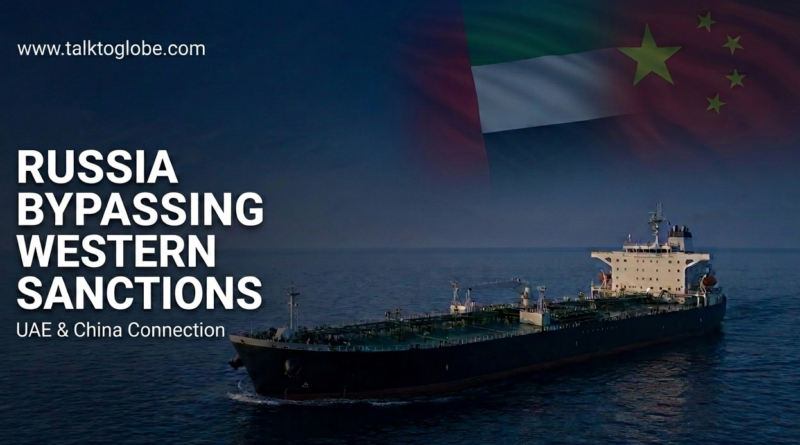
How Russia Is Bypassing Western Sanctions in 2026 Through UAE and China
In March 2022, the West declared economic war on Russia.
Thousands of the west imposed sanctions within weeks. Russian the West cut off Russian banks from SWIFT. Western companies raced to exit the Russian market. Leaders in Washington, Brussels, and London declared that the pain would force Vladimir Putin to end the war in Ukraine.
Three years later, Russia’s economy is not crippled. It is smaller, more isolated, and more dependent on China than before, but it is functioning. And the reason it is still functioning tells one of the most important stories in modern geopolitics: how Russia is bypassing Western sanctions in 2026 through a sophisticated web of intermediaries, shell companies, shadow fleets, and neutral countries with the UAE and China at the centre of it all.
Furthermore, the strategies Russia is using are not just clever, they are reshaping global finance, trade routes, and the future of the US dollar itself. Therefore, this is not just a story about Russia. It is a story about how the global economic order is shifting in 2026.
Key Numbers at a Glance: 700,000+ Western-brand cars delivered to Russia via China (Reuters). $314M+ in Russian oligarch property in Dubai. 96.4 tons of Russian gold imported by UAE in 2022 alone. according to OANDA analysts, an estimated 90% of Russia-China trade now bypasses the dollar. EU has issued 20 sanctions packages, and counting.
Why Sanctions Are Hard to Enforce: A Quick History Lesson
Sanctions are not a wall. They are a speed bump.
History tells us this clearly. When Napoleon imposed his Continental Blockade against Britain in 1806, the British simply rerouted trade through the United States and established smuggling networks across Europe. US sanctioned Iran, Iranian oil kept flowing through Turkey, Iraq, and UAE intermediaries. When North Korea was isolated, it kept building nuclear weapons through ship-to-ship transfers at sea.
Russia is the ninth-largest economy in the world. Its pre-war imports exceeded $300 billion annually. Cutting off an economy that size would require the cooperation of every country on Earth, and as Russia’s sanctions bypass network shows, that cooperation simply does not exist. China, India, Turkey, the UAE, Kazakhstan, and Armenia have all become bridges between Russia and the global economy it was supposed to be cut off from. However, each country has its own reasons, and none of them are doing Russia any favours for free.
How Russia Is Using the UAE to Bypass Western Sanctions
Dubai was already a favourite destination for wealthy Russians before 2022. After the invasion of Ukraine, it became something else entirely, a financial lifeline.
The UAE never imposed sanctions on Russia. As a matter of official policy, Abu Dhabi declared itself neutral, stating that it follows UN Security Council resolutions, not unilateral Western sanctions. In practice, this neutrality created one of the world’s most valuable grey zones for Russian money, Russian oil, and Russian gold.
Within weeks of the 2022 invasion, Russian oligarchs began arriving in Dubai. According to the Tactics Institute for Security and Counter-Terrorism, at least 38 Putin-linked Russians owned property in Dubai collectively valued at over $314 million. The Russian Business Council estimated that 3,000 UAE-based companies were Russian-owned by end of 2022.
The gold trade is even more revealing. The UAE imported 96.4 tons of Russian gold in 2022 alone, with nearly a thousand gold shipments recorded in just over a year. Russian gold would arrive in Dubai, be reprocessed or re-certificated, and re-enter global markets as ‘UAE gold’ effectively concealing its origin. This is part of why the UAE’s position in global finance is so complex in 2026.
As a result, the US Treasury took notice. OFAC sanctioned UAE-based ARX Financial Engineering Limited for helping Russian investors transfer assets to the Emirates. By 2026, the US, EU, and UK have sanctioned over 30 UAE-based entities, but the networks keep adapting faster than enforcement can follow.
The 7 Methods Russia Uses to Bypass Western Sanctions
Here is a clear breakdown of exactly how Russia is bypassing Western sanctions in 2026 each method explained simply, with the country involved and how the West is responding:
1. The Shadow Oil Fleet
Russia bought ageing oil tankers from Western companies, primarily Greek operators and uses them to carry oil outside Western insurance, financing, and tracking systems. These vessels transport Russian oil above the Western-imposed price cap without triggering sanctions, delivering to ports in UAE, India, and China.
Key country: UAE (Fujairah terminal), India, China
Western response: EU sanctioned 50+ specific vessels by 2026. However, new ships keep entering the fleet faster than enforcement can designate them.
2. Gold Laundering Through Dubai
Russian gold is shipped to the UAE in large volumes 96.4 tons in 2022 alone. In Dubai’s gold market, it is reprocessed and re-certificated as ‘UAE gold,’ then sold back into global commodity markets with its Russian origin effectively erased. Because gold is a physical asset, it is almost impossible to track once it changes hands in a neutral jurisdiction.
Key country: UAE (Dubai gold souk and free zones)
Western response: UAE is under increasing Western pressure to tighten gold import controls. Progress has been slow.
3. Western Cars Through China 700,000 and Counting
According to a Reuters investigation, more than 700,000 Western-brand vehicles have been delivered to Russia since the invasion, routed through China. Some are manufactured in China through joint ventures with Western brands. Others are produced elsewhere, exported to China, registered as ‘sold,’ then reclassified as used vehicles before export to Russia avoiding automaker compliance and benefiting from Chinese auto subsidies. Reuters investigation on cars via China
Key country: China (primary conduit)
Western response: Western automakers have complained but have limited enforcement power. The EU is considering broader secondary sanctions on Chinese auto intermediaries.
4. Shell Companies in UAE Free Zones
Russian-affiliated entities register companies in UAE free trade zones, where ownership rules are flexible and oversight is limited. These shell companies import dual-use goods (electronics, microchips, machine tools) that are then shipped onward to Russia. The free zone structure makes it extremely difficult to establish the ultimate beneficial owner.
Key country: UAE, Turkey, Kazakhstan
Western response: Over 30 UAE-based entities sanctioned by US, EU, and UK between 2024 and 2026. New UK end-user licensing regulations came into force May 2026.
5. Cryptocurrency Payments
Russian rubles are converted into stablecoins through UAE-based and Eurasian cryptocurrency exchanges, then transferred internationally, completely bypassing the SWIFT system that Western financial sanctions rely on. This method is used particularly for purchasing dual-use electronics (drone components, microchips) needed for weapons manufacturing.
Key country: UAE, Eurasia
Western response: Over 10 cryptocurrency exchanges and fintech firms sanctioned. However, decentralised crypto networks are extremely difficult to fully block.
6. Yuan-Based Trade With China — Bypassing the Dollar Entirely
Perhaps the most consequential method. According to OANDA financial analysts, an estimated 90% of Russia-China trade is now conducted in yuan and rubles no US dollars, no SWIFT, no exposure to Western financial sanctions. China’s CIPS payment system is being linked directly to Russia’s SPFS system, creating a permanent alternative payment rail that cannot be sanctioned by Western governments.
Key country: China (direct bilateral trade)
Western response: US pushed G7 for 100% tariffs on Chinese and Indian goods facilitating Russian oil purchases. This is reshaping global trade as analysed in our coverage of the
7. Parallel Imports Through Central Asia
Goods produced in or exported from Western countries are shipped to Kazakhstan, Armenia, or Kyrgyzstan countries with existing trade relationships with both Russia and the West. They are then re-exported to Russia as goods ‘of Central Asian origin,’ disguising their actual source. Armenia’s imports from the EU surged dramatically in 2022, with much of the increase likely re-exported to Russia.
Key country: Kazakhstan, Armenia, Kyrgyzstan, Turkey
Western response: New UK end-user licensing rules introduced April 2026 specifically target this ‘diversion risk.’ Importers must now obtain licences when notified of diversion risk.
→ global manufacturing and supply chain shifts of 2026
Are Western Sanctions on Russia Actually Working??
This is the question Western politicians avoid, and Russia’s defenders oversimplify.
The honest answer is: partially, unevenly, and with significant unintended consequences.
On the positive side, Russia’s access to advanced Western semiconductors has been genuinely disrupted. Its financial system is more isolated than at any point in modern history. The economy has contracted, and Russia has been forced to accept lower-quality alternatives at higher prices and longer delivery times.
However, the most important unintended consequence is this: by weaponising the dollar-based SWIFT system, Western governments have given every non-Western country a powerful incentive to build alternatives. More than 50 countries have expressed interest in BRICS Pay a decentralised payment system designed to bypass dollar dominance. Therefore, Russia’s methods for bypassing Western sanctions may outlast the Ukraine war itself, permanently reshaping global financial architecture.
Furthermore, the shadow tanker fleet was largely built from ships sold by Western companies themselves, meaning Western businesses equipped Russia with the very tools it uses to evade Western sanctions. It is one of the more uncomfortable ironies of the entire sanctions regime.
Sanctions Scorecard: What’s Working, What Isn’t
A simple breakdown of sanctions effectiveness by sector in 2026:
| Area | Verdict | What’s Actually Happening |
| Technology / Chips | Working | Russia cannot access advanced Western semiconductors, forced to use older tech and Chinese alternatives |
| Banking / SWIFT | Partial | Major Russian banks excluded, but according to analysts, an estimated 90% of Russia-China trade has moved to yuan, bypassing SWIFT |
| Oil Revenue | Leaking | Shadow fleet keeps oil flowing via UAE, India; price cap is being consistently exceeded |
| Car Imports | Failed | 700,000+ Western-brand cars delivered via China since 2022, more than before sanctions |
| Gold Trade | Failed | UAE gold market absorbing Russian gold at scale, nearly impossible to trace once reprocessed |
| Oligarch Assets | Partial | Some assets frozen in EU/UK but most moved to Dubai before sanctions tightened |
| Overall Economy | Contracted, not collapsed | GDP smaller, inflation higher, growth slower, but Russia is still functioning and funding a war |
Sources: OANDA Sanctions Paradox Report, Reuters, UK Parliament Research Briefing, EU Sanctions Index 2026. UK Parliament Russia sanctions briefing 2026

What This Means for Pakistan: 3 Things to Watch
Pakistan sits in a uniquely important position in this story, not as a participant in sanctions evasion, but as a country whose economic relationships are being directly reshaped by its consequences.
- Oil prices and import costs: Russia’s continued oil exports through shadow fleets and UAE intermediaries have kept global supply higher than it would otherwise be moderating prices. If sanctions truly cut Russian oil off from markets, Pakistan’s petroleum import bill would be significantly higher.
- UAE economic environment: Pakistan’s 1.6 million workers in the UAE operate in a financial environment where Russian money has significantly shaped real estate prices and banking volumes. As Western pressure on UAE tightens, ripple effects on Pakistan’s expat community are possible. Related: Pakistan’s economic ties with the UAE in 2026
- De-dollarisation opportunity: Pakistan has long struggled with dollar shortages. As yuan-based trade grows and BRICS Pay expands, Pakistan may find new options for international transactions outside the dollar system potentially reducing vulnerability to currency crises.
Conclusion: The Sanctions Paradox
The story of how Russia is bypassing Western sanctions in 2026 is ultimately a story about the limits of economic coercion in a multipolar world. The West imposed the most extensive sanctions regime in history, and yet Russia is still exporting oil, importing cars, moving money through Dubai, and building alternative payment infrastructure with China.
The sanctions have imposed real costs. However, they have also created a powerful incentive for Russia and its partners to build financial systems that will exist long after any peace agreement. The unintended consequence of weaponising the dollar may be the beginning of its slow retreat as the world’s dominant reserve currency.
For businesses, investors, and governments watching global markets, this is not just a geopolitical story. It is a signal that the rules of international trade and finance are being rewritten in real time. Follow TalkToGlobe for continuing coverage of how global geopolitics is reshaping business and trade.
Frequently Asked Questions
How is Russia bypassing Western sanctions in 2026?
Russia bypassing Western sanctions in 2026, through seven main methods: a shadow oil tanker fleet operating outside Western insurance systems; gold laundering through Dubai’s market; 700,000+ Western-brand cars routed via China; shell companies in UAE free zones importing dual-use goods; cryptocurrency exchanges converting rubles to stablecoins; yuan-based trade with China that bypasses SWIFT entirely; and parallel imports through Kazakhstan, Armenia, and Turkey. Each method exploits gaps in international enforcement that are extremely difficult to close without global cooperation.
Is the UAE helping Russia avoid sanctions?
The UAE maintains official neutrality and has not imposed Western unilateral sanctions on Russia. In practice, this has made Dubai a hub for Russian money, gold, and business since 2022. The US Treasury has sanctioned multiple UAE-based entities for facilitating Russian sanctions evasion. At least 38 Putin-linked Russians own over $314 million in Dubai property. The UAE has faced increasing Western pressure, but as a neutral state it is not legally obligated to enforce sanctions it has not adopted.
Are Western sanctions on Russia working in 2026?
Partially. Sanctions have genuinely disrupted Russia’s access to advanced Western semiconductors and isolated its financial system from Western capital markets. However, they have largely failed to stop Russian oil exports, car imports, or gold trade. Furthermore, the most significant unintended consequence is accelerating de-dollarisation, more than 50 countries are exploring BRICS Pay alternatives, and the yuan’s role in global trade has grown significantly as a direct result of sanctions policy. OANDA Sanctions Paradox analysis
What is Russia’s shadow fleet and how does it work?
Russia’s shadow fleet is a collection of ageing oil tankers that operate outside Western insurance, financing, and flag-state systems. This allows Russian oil to be transported without triggering the Western price cap. The fleet was largely built from ships sold to Russia by Western companies, primarily Greek operators, after the 2022 invasion. By 2026, the EU has sanctioned over 50 specific vessels, but the fleet continues to operate because ships keep being added faster than they can be designated.
How does Russian gold get laundered through the UAE?
Russian gold is shipped to the UAE in large volumes, nearly 1,000 gold freight movements were recorded between February 2022 and March 2023 alone. In Dubai’s gold market, Russian-origin gold is reprocessed, re-certificated, and sold back into global markets as ‘UAE gold.’ This effectively erases its Russian origin, allowing it to re-enter commodity markets without triggering sanctions. The UAE’s position as a major gold trading hub, combined with its neutral stance, makes this route particularly difficult to close.
Why is China helping Russia bypass sanctions?
China has not officially committed to helping Russia bypass sanctions, but the volume of goods reaching Russia through Chinese intermediaries is significant. China’s motivations are primarily economic, Russia supplies cheap oil, gas, and raw materials in return for Chinese manufactured goods. Furthermore, according to OANDA research, an estimated 90% of Russia-China trade now bypasses the dollar entirely, which serves China’s broader interest in reducing dollar dependency. Chinese firms are cautious about direct violations that could trigger US secondary sanctions, but grey-market schemes continue at scale.
What does Russia sanctions evasion mean for Pakistan?
For Pakistan, Russia’s sanctions evasion has three direct consequences. First, continued Russian oil exports through shadow fleets have kept global oil prices lower than they would otherwise be moderating Pakistan’s petroleum import costs. Second, Pakistan’s 1.6 million workers in the UAE operate in an environment shaped significantly by Russian money flows increasing Western pressure on UAE could have knock-on effects. Third, the growth of yuan-based trade and BRICS Pay could give Pakistan new options for international transactions outside the dollar system. Read more: Pakistan’s economic ties with the Middle East in 2026
