
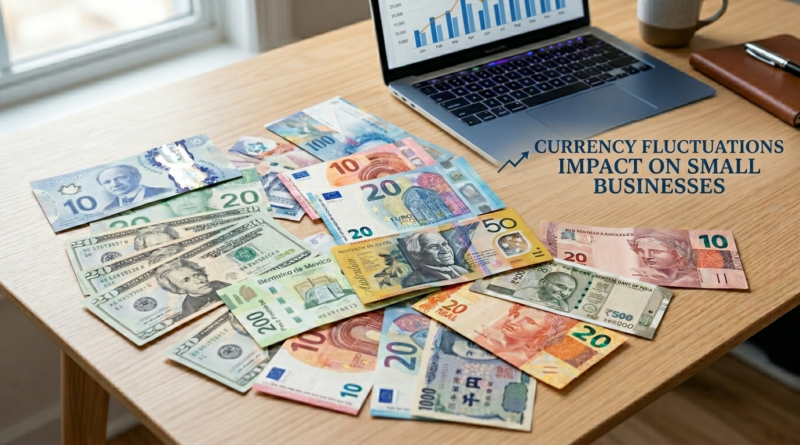
How Currency Fluctuations Impact Small Businesses: And What Smart Owners Do About It
A Turkish textile exporter ordered €30,000 worth of fabric from a Chinese supplier in January. The invoice was due three months later. By April, the exchange rate had shifted and the same order now cost him €31,413.
He had not made any mistakes. He had not changed suppliers or renegotiated terms and had simply run a small business in a world of floating exchange rates and absorbed €1,413 in losses he never saw coming.
This is what the currency fluctuations impact on small businesses actually looks like. Not dramatic crashes or financial crises. Just quiet, recurring losses that accumulate over months and years, eroding margins that were already thin.
A landmark study by Donald Lessard and John Lightstone, published in the Harvard Business Review, found that an exporter with a nominal profit margin of 15% could see ‘real’ margins swing anywhere from -30% to +35% purely due to currency movements. That range is not a rounding error. It is the difference between a profitable year and an existential crisis.
The numbers:
• Major currencies swung 5–7% within weeks between 2023 and 2025, according to industry data.
• 63% of SME exposures to non-euro currencies are return-reducing, per ScienceDirect research.
• SMEs with foreign sales face greater FX-related performance losses than those without exports.
Why Small Businesses Feel This More Than Large Ones
Large multinationals have entire treasury departments dedicated to currency risk. They employ FX specialists, maintain sophisticated hedging programmes, and have the financial reserves to absorb unexpected losses from exchange rate movements.
Small businesses have none of that. A small manufacturer in Germany importing components from Southeast Asia, or a coffee shop owner in the UK sourcing beans from Ethiopia, is making currency decisions by default, simply by the act of doing international business, without necessarily having a strategy to manage the risk.
The FX volatility hurts SMEs is disproportionate precisely because of this asymmetry. When a currency moves 5% against you, a large company absorbs it. A small business with 8-12% margins may find its entire profit wiped out. According to research published by ibanfirst, SMEs that implement a currency risk mitigation strategy can restrict their margin swings from the brutal -30% to +35% range down to a much more manageable 8% to 30%. The strategy does not eliminate risk, it makes it survivable.
Related: how the US dollar’s changing dominance is affecting global trade
The 4 Ways Currency Moves Quietly Hurt Your Business
Most business owners think about currency risk in one direction: ‘the rate changed and my supplier charged me more.’ The reality is more layered than that.
1. Your Supplier Costs Change Without Warning
This is the most obvious effect and the Turkish textile example above illustrates it perfectly. When you agree a price in a foreign currency, you are locking in a commitment while the exchange rate floats freely beneath it. A three-month production cycle can easily see a 3-5% currency move enough to meaningfully erode margins on a thin-margin business.
The compounding problem: many small businesses invoice customers in their home currency while paying suppliers in foreign currencies. This means the entire FX risk sits with the buyer, the small business owner while the supplier is fully protected.
2. Your Export Demand Becomes Unpredictable
Currency movements can create sudden, unexplained demand surges, which are just as dangerous as demand drops. Imagine a UK-based craft goods seller suddenly receiving a flood of orders from American buyers after sterling weakens against the dollar. The products appear cheaper to US customers, so demand jumps.
The problem: the business owner realigns production schedules, hires extra staff, orders more materials and then the currency reverses. Demand falls flat. The costs remain. The surge was a currency effect, not a real market signal and a business that could not distinguish the two has now overextended itself.
3. Your Transport and Logistics Costs Swing
Oil prices are closely correlated to USD strength, according to a 2020 study cited by ibanfirst’s FX research. When the dollar strengthens, oil prices tend to move. When oil prices move, logistics costs move. For a small business paying for international shipping, this creates an indirect currency exposure, you may not pay your shipper in a foreign currency, but you are paying rates that are themselves influenced by currency markets.
This indirect exposure is the one most small business owners never see coming, because it does not show up as a line item labelled ‘currency risk.’ It just looks like rising costs.
4. Your Employee Bonuses and Reporting Look Wrong
For any business with international operations or foreign currency revenue, exchange rate movements can make internal performance metrics deeply misleading. A sales team might genuinely outperform their targets, only for the final revenue number, translated back to the home currency, to look like underperformance. Or vice versa: weak sales masked by a favourable currency move.
This matters for small businesses making strategic decisions, whether to expand into a new market, hire new staff, or invest in new equipment based on performance data that currency distortion has made unreliable.
Currency Risk by Business Type: What to Watch
Not every business faces the same exposure. Here is a practical overview of how currency risk differs by business model:
| Business Type | Main Currency Risk | Real Example | Risk Level |
| Importer / Buyer | Supplier costs rise when home currency weakens | Turkish fabric buyer: €30k order became €31.4k | 🔴 High |
| Exporter / Seller | Revenue drops when home currency strengthens | UK craft seller: dollar weakens, US orders disappear | 🔴 High |
| E-commerce (global) | Multi-currency revenue converts at moving rates | Shopify seller pricing in USD paid in GBP, margin erodes | 🟡 Medium |
| SaaS / Subscriptions | Recurring revenue in foreign currency fluctuates monthly | $99/month subscription worth less each quarter if USD falls | 🟡 Medium |
| Service / Freelance | Invoices in foreign currency, conversion timing matters | Freelancer invoicing in USD, paid in euros, late payment costs extra | 🟡 Medium |
| Local-only business | Indirect exposure via transport, energy costs | Coffee shop: oil prices rise → delivery costs up → margins squeezed | 🟢 Lower |
Sources: ibanfirst SME FX research, Harvard Business Review Lessard-Lightstone study, ScienceDirect UK SME research.
What Actually Works: 4 Practical Strategies
The good news is that currency risk is manageable even for small businesses without treasury departments. These are the strategies that actually work in practice, not just in finance textbooks.
Forward Contracts: Lock In Today’s Rate for Future Payment
A forward contract is an agreement with a bank or FX provider to exchange currency at a fixed rate on a future date. If you know you will need to pay a supplier €30,000 in three months, you lock in today’s rate now regardless of where the rate moves between now and then.
This eliminates the uncertainty entirely. You know your costs. You can price your products accordingly. The Turkish textile exporter in our opening example would not have faced that surprise €1,413 charge if he had used a forward contract.
According to StoneX’s currency analysis, businesses that hedge even 50% of their FX exposure significantly reduce the volatility of their margins without needing to hedge everything perfectly.
Invoice in Your Home Currency When Possible
The simplest risk transfer: invoice your customers in your own currency. This shifts the FX risk to them — the party better positioned to manage it in their own financial context. Not every customer will accept this, but many will particularly if you have a strong product or service and the relationship is established.
The counterbalance: invoicing in a stronger currency (like USD or EUR) can make you look expensive to buyers in weaker-currency markets, reducing competitiveness. There is a trade-off, but for businesses where margin preservation matters more than volume growth, home-currency invoicing is the cleanest protection.
Build a Currency Buffer Into Your Pricing
If you cannot hedge formally and cannot invoice in your home currency, the next best option is to build a 3-5% currency buffer into your prices effectively a hidden exchange rate insurance premium baked into your margins.
This works best in markets where you have pricing power, where customers are paying for quality or uniqueness, not just competing on price. In commodity markets where competitors are pricing aggressively, this buffer can make you uncompetitive. Know your market before applying this approach.
Use Multi-Currency Accounts
Modern fintech platforms, Wise Business, Revolut Business, Airwallex allow small businesses to hold and transact in multiple currencies without converting at every transaction. If you receive USD from a US customer, you can hold that USD and use it to pay a USD-denominated supplier never converting at all, and therefore never incurring conversion risk or fees on that loop.
This is one of the practical ways that fintech and digital payment infrastructure are transforming how small businesses operate globally. The infrastructure that used to require a corporate banking relationship is now available to any business with a laptop.

The Bigger Picture: Why This Is Getting Harder
Currency volatility has increased significantly since 2020. Brexit, COVID-19, the war in Ukraine, and most recently the US-China tariff escalation have created a global FX environment where 5-7% currency swings within weeks are no longer unusual, they are routine, according to industry data published in 2025.
The macroeconomic backdrop makes this worse. As we analyzed in our coverage of whether the US dollar is losing its dominance in global trade, the global currency system is in a period of genuine structural change. Central banks are diversifying away from the dollar. New payment systems are emerging. Trade is increasingly being settled in currencies other than USD.
For small businesses, this means the currency environment they learned to operate in a dollar-dominated, relatively stable system is becoming more complex and less predictable. The businesses that thrive in this environment will be the ones that treat currency risk as a strategic business issue, not an accounting inconvenience.
The Bottom Line
The exchange-rate pressure on small businesses is not theoretical, it is the difference between a 15% margin and a loss, as the Harvard Business Review research shows. It is the €1,413 the Turkish exporter did not budget for. It is the UK craft seller who overproduced for demand that evaporated when sterling recovered.
Currency risk is not going away. If anything, the structural changes happening in global finance right now de-dollarisation, rising FX volatility, new payment corridors mean the environment is becoming more complex, not less.
The good news: the tools to manage this risk have never been more accessible. Forward contracts, multi-currency accounts, smart invoicing practices none of these require a treasury department. They require awareness, and a decision to treat FX as part of your business strategy.
For more on how global financial shifts are reshaping business: how global markets are transforming small and medium businesses in this decade
Frequently Asked Questions
How do currency fluctuations impact small businesses?
The exchange-rate pressure on small businesses works through four main channels: supplier costs change when exchange rates move against you; export demand becomes unpredictable as currency shifts make your products cheaper or more expensive in foreign markets; indirect costs like transport and energy rise when oil prices (which correlate with USD strength) move; and internal performance metrics become misleading when results are translated across currencies. According to a Harvard Business Review study, an exporter with a nominal 15% profit margin can see real margins swing from -30% to +35% due to currency alone.
What is the biggest currency risk for a small business?
For most small businesses engaged in international trade, the biggest currency risk is invoice currency mismatch agreeing a price in a foreign currency and then having the exchange rate move between agreement and payment. A three-month production or delivery cycle can easily see a 3-5% currency move, which on thin margins can eliminate profit entirely. This risk is greatest for importers and exporters, but also affects e-commerce sellers, SaaS businesses, and freelancers who invoice internationally.
How can small businesses protect themselves from currency fluctuations?
There are four practical strategies. First, forward contracts lock in today’s exchange rate for a future payment date, eliminating uncertainty entirely. Second, invoicing in your home currency shifts FX risk to your customer. Third, building a 3-5% currency buffer into pricing creates an implicit insurance margin. Fourth, using multi-currency accounts (Wise Business, Revolut Business, Airwallex) allows you to hold and pay in foreign currencies without converting eliminating conversion risk on matched currency loops. Even implementing one of these strategies significantly reduces the currency risk for your business.
Do currency fluctuations affect businesses that only sell locally?
Yes, indirectly. Even businesses that do not import or export internationally face currency exposure through energy and transport costs. Oil prices correlate closely with USD strength, meaning fuel and logistics costs for local businesses can swing based on global currency markets. Additionally, if local suppliers import their raw materials, currency moves affect their costs, which are eventually passed on to you. Currency risk for local businesses is lower but not zero.
What is a forward contract and should small businesses use one?
A forward contract is an agreement with a bank or FX provider to exchange a specific amount of currency at a fixed rate on a future date. For example, a business that needs to pay a supplier €50,000 in three months can lock in today’s rate now regardless of where the euro moves. According to StoneX’s currency risk analysis, businesses that hedge even 50% of their FX exposure significantly reduce margin volatility. For small businesses with predictable international payments, forward contracts are one of the most effective and accessible risk management tools available.
Why is currency volatility getting worse for small businesses?
Currency volatility has increased significantly since 2020. Brexit, COVID-19, the Russia-Ukraine war, and the US-China tariff escalation have created an FX environment where 5-7% currency swings within weeks are now routine. The broader structural shift in global finance including the US dollar’s declining share of global reserves and the growth of alternative payment systems is adding long-term uncertainty to an already complex system.
What is the best multi-currency account for small businesses?
The most widely used multi-currency accounts for small businesses are Wise Business (formerly TransferWise), Revolut Business, and Airwallex. All three allow businesses to hold, receive, and pay in multiple currencies without forced conversion, significantly reducing FX exposure and transaction costs compared to traditional bank accounts. Wise Business is particularly popular for freelancers and small exporters. Airwallex is stronger for e-commerce businesses with complex multi-market operations. Revolut Business offers the broadest feature set but is better suited to businesses with predictable, moderate international payment volumes.
