
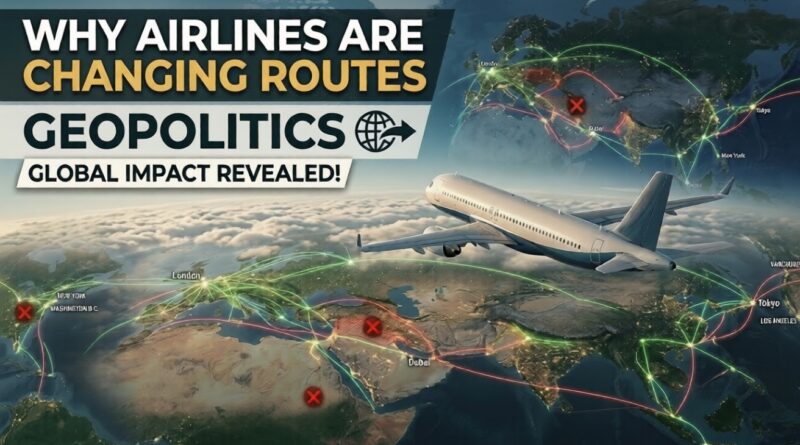
Why Airlines Are Changing Routes? How Geopolitics Is Rewriting Global Aviation
When you board a flight from London to Singapore, you do not think about the route. You think about the seat, the meal, the arrival time.
The airline thinks about something else entirely.
It thinks about which countries are at war, which airspace has closed overnight, whether the insurance underwriter has flagged a new corridor as high-risk, and how many extra tonnes of fuel the detour will burn. Geopolitics has always shaped aviation. What has changed is the pace.
In 2019, the world’s major flight corridors were largely stable. Airlines had spent decades optimising routes down to the minute and the litre. Then Russia invaded Ukraine. Then the Middle East erupted. Then the Gulf went to war. In five years, three of the world’s most important aviation corridors became unpredictable and the industry is still adapting.
Geopolitical instability is changing the invisible maps that airlines used to follow without a hitch. Flights are getting longer, prices are going up, and the world’s most efficient air routes no longer exist.
The Invisible Infrastructure Nobody Thinks About
Airspace is not neutral territory. It belongs to countries. Every flight that crosses a national border is using that country’s airspace and paying for the right to do so through overflight fees. Most passengers have no idea this system exists. It works so smoothly that it is invisible.
Until it doesn’t. When a country closes its airspace, whether due to conflict, sanctions, or political dispute every route that passed through it must instantly find an alternative. There are no advance warnings. Airlines sometimes discover an airspace closure from a NOTAM (Notice to Air Missions) with hours to spare. In practice, airlines often start avoiding airspace before official closures, because internal risk teams move faster than governments.
According to Airways Magazine’s airspace analysis, airlines typically begin deviating from at-risk corridors before any formal ban is issued a proactive response driven by insurance requirements, safety protocols, and the real-time intelligence their operations teams receive.
Russia Closed Its Airspace. The Ripple Effect Is Still Running.
The 2022 Ukraine invasion triggered the largest single airspace disruption in aviation history. Russia closed its airspace to Western carriers. Western countries banned Russian airlines. Overnight, the most direct route between Europe and East Asia across Siberia, became unavailable to most of the world’s major airlines.
The numbers are staggering. According to Airport World’s conflict impact analysis, rerouting due to the Russia-Ukraine conflict added over $2.25 billion annually in additional fuel and operational costs across European carriers alone. Average European flight times increased by approximately 7%. More than one million annual flights were affected.
The Siberian route had been one of aviation’s great efficiencies shaving hours off Europe-Asia journeys and reducing fuel burn significantly. Airlines had built their entire East-West scheduling around it. Losing it meant redesigning networks that had taken decades to optimise.
The competitive distortion is also significant and rarely discussed: Chinese carriers, Turkish Airlines, Emirates, and Air India can still use Russian airspace, because their countries did not sanction Russia. They fly shorter, cheaper routes between Europe and Asia while their Western competitors burn extra fuel on longer detours. Same destination, different cost structure, different ticket price.
Related: how Russia’s sanctions have reshaped global trade routes
The Gulf Was the Backup. Now It Is Also Disrupted.
After Russia closed its airspace, airlines compensated by routing more traffic through the Middle East corridor the vast airspace spanning the Gulf states, connecting Europe and Africa to Asia and beyond. The Gulf’s mega-hubs Dubai, Doha, Abu Dhabi absorbed the extra load and thrived.
That corridor became the world’s most strategically critical aviation route. And then the Gulf went to war.
The Iran conflict that began in early 2026 triggered simultaneous airspace closures across Iran, Iraq, Syria, Lebanon, and parts of the Gulf. More than 11,000 flights were cancelled in the opening days alone, per aviation data firm Cirium. The three biggest Gulf carriers Emirates, Etihad, and Qatar Airways all suspended multiple routes simultaneously. Airlines that had been rerouting north to avoid Russia now had no reliable southern backup.
For Air India, the situation was particularly acute. Its transatlantic routes had been routed through West Asian airspace. When that closed, Air India halted its entire East-West service overnight. For European carriers, fuel surcharges jumped to $85–$145 per ticket compared to $40–$60 during stable periods, according to industry data a direct cost passed to passengers.
Related: how the Gulf conflict is affecting oil markets and regional business
The Real Cost Beyond the Ticket Price
Passengers see higher fares. The industry is absorbing something far more complex.
Fuel: Fuel accounts for 30-40% of an airline’s operational costs, according to IATA data. A 5-10% increase in route distance, which a reroute via the Caspian Sea easily produces does not just burn 5-10% more fuel. It burns more than that, because the aircraft must carry extra fuel for the longer route, and that extra fuel weight itself increases consumption. A 15% longer route can mean 20-25% more fuel burned.
Insurance: War risk insurance premiums for routes near conflict zones increase dramatically. For carriers flying near disputed areas, insurance costs can spike overnight. According to The Flying Engineer’s airspace analysis, war risk insurance costs increased dramatically for airlines operating near conflict zones and these costs are non-negotiable. Fly without adequate insurance and you cannot operate.
Crew: Longer routes mean more crew hours. International aviation regulations limit how many hours pilots and cabin crew can work continuously. A flight that used to take 11 hours and now takes 13.5 hours may require an extra crew member positioned somewhere along the route adding cost that scales with every affected flight.
Environment: A November 2025 study in Communications Earth and Environment found that airspace closures increased global aviation CO2 emissions measurably. Among 750,000 analysed flights, forced detours produced significantly more carbon dioxide than the same routes pre-closure. This creates a paradox: airlines investing in sustainable aviation fuel and efficient aircraft are having those gains partially offset by geopolitically-forced detours.
Three Airports That Geopolitics Made and Unmade
The most interesting story in aviation geopolitics is not about airlines. It is about airports and how conflicts can instantly change which ones matter.
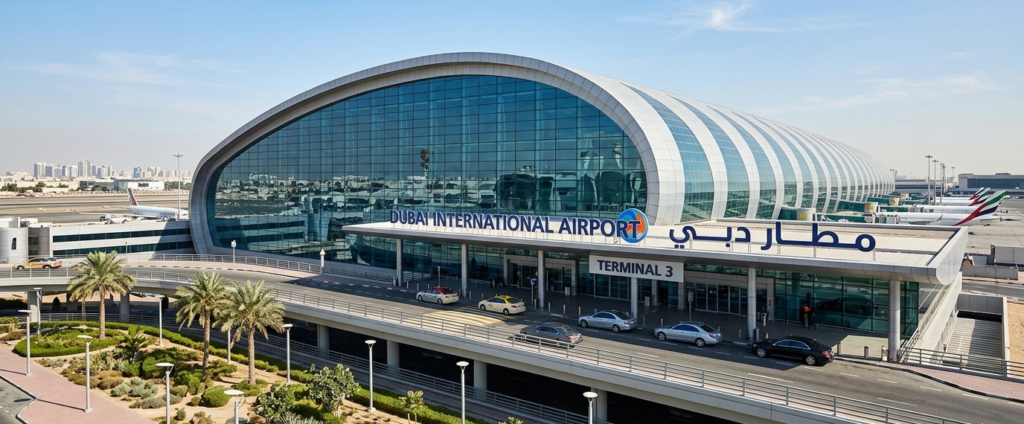
Dubai: Made by Neutrality: Dubai International became the world’s busiest international airport partly because the UAE positioned itself as politically neutral. Airlines from countries that would not fly over each other’s territory could both stop in Dubai. Capital from countries sanctioned by the West moved through Dubai freely. The airport grew because the country’s geopolitical positioning made it genuinely useful to everyone a pattern we analysed in our piece on why small countries are winning the global economy.
Doha: Nearly Unmade by Proximity: Hamad International had been expanding aggressively, positioning Qatar Airways as a global competitor to Emirates and Etihad. Then the Iran war placed it in the direct line of conflict. Iranian missiles targeted US bases in Qatar. Qatari airspace closed. The airport that had just been named world’s best found itself severely restricted for months not because of any decision Qatar made, but because of where it sits on a map.
The Alternative Hubs: Made by Disruption: Istanbul, Tbilisi, and Almaty all saw traffic surges after Russia’s airspace closed. Airports in South and Southeast Asia are positioning as alternative transit points for Asia-Europe routes that can no longer rely on either Siberia or the Gulf. Disruption does not just hurt, it redirects. Some airports will emerge from this period structurally more important than they were before.
Is This Permanent? What Aviation Looks Like Next
The honest answer is that nobody knows and the airlines are planning for both scenarios simultaneously.
Aviation analysts expect Gulf airspace restrictions to persist through at least 2027-2028, possibly longer, according to The Flying Engineer. Reopening would require not just a ceasefire, but credible peace negotiations, regulatory clearance from international aviation authorities, and airlines actually resuming route filings none of which happen quickly.
Meanwhile, airlines are not simply waiting. They are permanently redesigning network architecture to reduce dependency on any single corridor. Route planning that used to optimise for efficiency is now optimising for resilience building in alternatives that can be activated within hours when the next closure happens.
According to Earthian AI’s geopolitical risk analysis for airlines, the industry is shifting from historical volatility models to real-time geopolitical monitoring because traditional risk management cannot keep pace with the speed of modern airspace closures. An airspace can close within hours of a military strike. A sanctions designation can invalidate a leasing contract overnight.
The world’s air routes are, in a very literal sense, a map of global stability. The gaps in that map over Ukraine, over Iran, over disputed territories tell you exactly where the world’s conflicts are. And right now, that map has more gaps than at any point since the Cold War.
3 Things to Watch
1. Whether the Gulf corridor stabilises or fractures further. A durable Gulf ceasefire would partially restore one of the world’s most important aviation corridors. A resumption of conflict would drive fuel surcharges higher and force further network redesigns. The difference matters not just for airlines but for ticket prices globally.
2. Whether Chinese carriers’ Russian airspace advantage widens. Air China, China Eastern, and China Southern can still use Siberian routes that Western carriers cannot. If that advantage persists for years, it structurally reduces the competitiveness of European and American carriers on Asia routes regardless of anything those airlines do themselves.
3. Which alternative hubs emerge as permanent winners. Istanbul has already gained significantly. South and Southeast Asian airports are positioning for more transit traffic. The airports that invest in capacity now, while the Gulf and Siberian corridors are disrupted, will be structurally better positioned when routes eventually normalise. Or if they do not.
Aviation has always adapted. Routes changed after September 11. They changed after SARS. They changed after Ukraine. They are changing again now.
What is different this time is the simultaneous disruption of multiple major corridors something the industry has not experienced at this scale before. The resilience being built right now, route by route and contingency plan by contingency plan, will define global aviation for the next decade.
Follow TalkToGlobe for continuing analysis of how geopolitics is reshaping global trade, business, and economic power.
