
UAE Exits OPEC 2026: What It Means for Oil Prices and Global Energy Markets
In a move that stunned energy markets worldwide, the United Arab Emirates announced it will leave OPEC effective May 1, 2026. The decision, described as a ‘sovereign choice in the national interest’ ends nearly six decades of UAE membership in the world’s most powerful oil cartel. But what really drove this decision, and what happens next?
For anyone watching global energy markets, this is the most significant OPEC development in years. The UAE exits OPEC 2026 story is not just about oil, it is about shifting alliances, the Iran war, and the future of energy geopolitics in the Middle East.
Quick Facts: UAE was OPEC’s third-largest producer. It joined in 1967. It produced 3.4 million barrels per day before the Iran war. Effective exit date: May 1, 2026.
Why Did UAE Exit OPEC in 2026?
The decision did not happen overnight. Years of tension between Abu Dhabi and Riyadh over production quotas had been building beneath the surface. But three specific triggers pushed the UAE to act now.
1. The Iran War and Strait of Hormuz Crisis
When Iran began targeting UAE shipping and infrastructure with missile and drone attacks in early 2026, the Strait of Hormuz through which 20% of the world’s oil flows became nearly impassable. UAE oil production collapsed 44% in March alone, dropping from 3.4 million barrels per day to just 1.9 million.
Yet OPEC’s production quota framework still constrained the UAE. As a fellow OPEC member, Iran’s attacks were hitting the UAE — but OPEC had no mechanism to address this. The UAE concluded that staying made no strategic sense.
2. Years of Frustration Over Production Caps
The UAE has long argued it deserves a higher production quota within OPEC. With a current capacity of 4.85 million barrels per day, but OPEC forcing it to produce nearly 30% below that level the UAE was leaving billions of dollars on the table every year.
Meanwhile, Iraq and Russia were routinely exceeding their own OPEC quotas with little consequence. The UAE watched this happen for years and decided it was no longer worth staying bound by rules that others ignored.
3. The 5 Million BPD Ambition
The UAE has set an ambitious target: 5 million barrels per day of production capacity by 2027. This goal is impossible to achieve while constrained by OPEC membership. Independence gives Abu Dhabi the freedom to produce at full capacity and maximize revenue from its state oil company ADNOC’s investments.
As UAE Energy Minister Suhail Al Mazrouei stated: the exit is ‘the right time, with minimum impact on friends at OPEC’ diplomatic language that barely conceals years of built-up frustration.
UAE Exits OPEC 2026: What It Means for Oil Prices
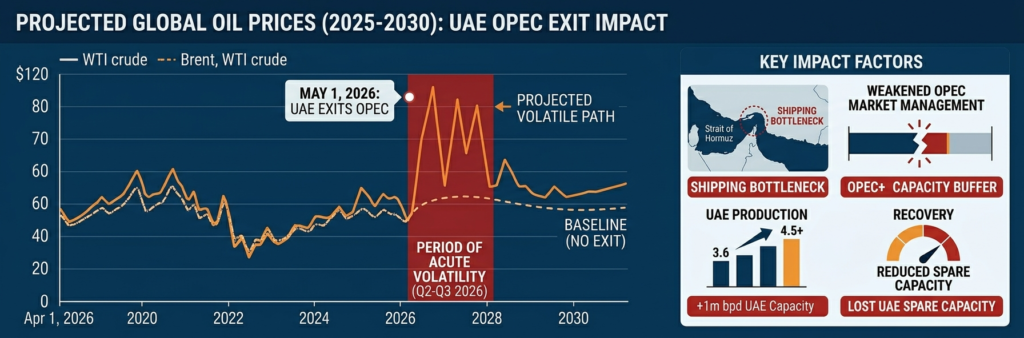
The immediate reaction in oil markets was surprisingly calm. Crude prices already above $110 per barrel due to the Strait of Hormuz crisis barely moved on the day of the announcement. Here is why, and what to expect next.
Short Term: Little Change
Right now, the Strait of Hormuz crisis is capping what the UAE can actually export regardless of OPEC membership. Iranian attacks and a US naval blockade mean that even with full production freedom, the UAE cannot get significantly more oil to market today.
So in the short term, this decision is symbolic but not yet impactful on global supply. UAE OPEC exit analysis.
Long Term: Potentially Market-Changing
When the current conflict resolves and the Strait reopens, the calculus changes entirely. A UAE free from OPEC constraints could pump at full capacity potentially 5 million barrels per day by 2027. This additional supply, hitting markets during a period of recovering demand, could push oil prices significantly lower.Global supply chain diversification
Energy analysts at Rystad Energy describe the UAE as effectively becoming a ‘normal non-OPEC producer’ one that pumps as much as it can, whenever it can, without cartel coordination. Global oil market data 2026.
OPEC Is Now Structurally Weaker
This is perhaps the most important long-term consequence. The UAE was one of only two OPEC members alongside Saudi Arabia with meaningful spare production capacity. Spare capacity is the critical tool that allows OPEC to influence prices during crises.
With the UAE gone, Saudi Arabia loses its most powerful ally in managing the cartel. OPEC still controls roughly 30% of global supply, but its ability to respond to price shocks in either direction is now meaningfully reduced.
What Does This Mean for Pakistan and the Middle East?
For readers following this story from Pakistan, the implications are real and practical.
- Oil import costs: Pakistan imports significant volumes of petroleum products. If UAE’s exit ultimately leads to lower global oil prices, Pakistan’s import bill could ease a welcome relief given ongoing economic pressure.
- Pakistan-UAE relations: The UAE remains one of Pakistan’s most important bilateral partners. This OPEC exit is a strategic pivot, not a signal of instability UAE’s economy remains strong and diversified beyond oil.
- Gulf stability concern: The deteriorating Saudi-UAE relationship is the bigger story to watch. These two countries have long been the anchor of Gulf stability. Growing friction between them could complicate regional security architecture.
- Remittance corridor: Over 1.6 million Pakistanis work in the UAE. The country’s economic trajectory which this OPEC exit is partly designed to protect directly affects Pakistani workers and their families. Pakistan Middle East relations
Saudi Arabia’s Response: A Blow to Riyadh
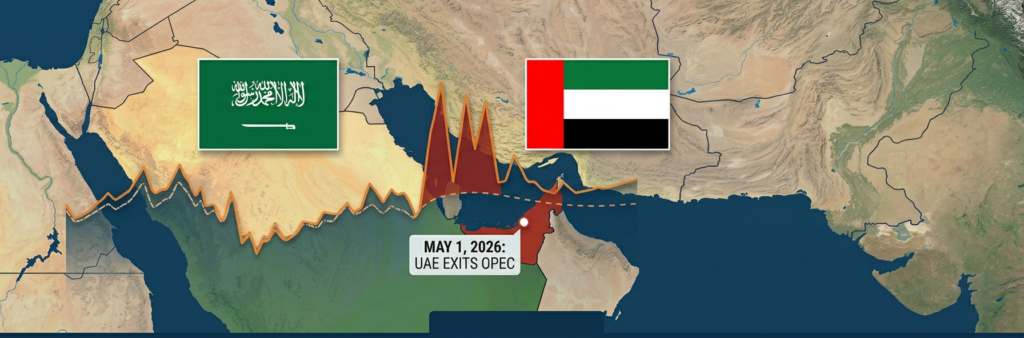
For Saudi Arabia, this is more than an energy story, it is a geopolitical blow. The UAE and Saudi Arabia were once considered inseparable Gulf allies, but their relationship has deteriorated significantly over the past three years.
The two countries have backed opposing sides in the Yemen conflict. They disagree on Iran policy. And the UAE’s growing ties with Israel formalized in the 2020 Abraham Accords represent a strategic direction Riyadh has not followed. The OPEC exit is the latest signal that Abu Dhabi is charting its own course, independent of Riyadh’s leadership.
Saudi Arabia still controls enormous spare capacity and remains the dominant force in oil markets. But managing OPEC without the UAE will be harder, and maintaining price discipline among remaining members just became more difficult.
The Bigger Picture: Is OPEC Finished?
OPEC has survived defections before. Qatar left in 2019. Ecuador and Gabon have come and gone. The cartel still controls roughly 30% of global crude supply, and Saudi Arabia’s dominance means it retains significant market influence. What is OPEC explained.
But the UAE’s departure is different in scale. No previous defector had the UAE’s combination of spare capacity, financial resources, and strategic weight. OPEC can continue, but it enters a new era with a structurally weaker hand.Global energy supply chain shifts
The more relevant question is whether other members watch UAE’s exit, see it as a viable path, and begin questioning their own membership. If OPEC production discipline breaks down further, the era of cartel-managed oil prices may genuinely be approaching its end.
What Happens Next: Timeline to Watch
- May 1, 2026: UAE’s OPEC exit becomes official.
- Q2-Q3 2026: Watch for UAE to begin signaling production increases as Hormuz situation evolves.
- Late 2026: If Strait of Hormuz reopens, UAE production ramp-up begins potential oil price pressure downward.
- 2027: UAE targets 5 million barrels per day capacity a milestone that will test global demand and OPEC cohesion.
Frequently Asked Questions
Why did UAE leave OPEC in 2026?
The UAE left OPEC in 2026 for three main reasons: First, Iran’s attacks on UAE infrastructure during the ongoing Iran war created a direct conflict of interest within the cartel. Second, the UAE had long been frustrated with OPEC production caps that prevented it from producing at full capacity. Third, the UAE wants to reach 5 million barrels per day by 2027 a goal impossible under OPEC constraints.
When does UAE’s OPEC exit take effect?
The UAE’s OPEC exit is effective May 1, 2026. The announcement was made on April 28, 2026, just days before the official exit date.
How will UAE leaving OPEC affect oil prices?
In the short term, oil prices are unlikely to change significantly because the Strait of Hormuz crisis is already limiting UAE exports. However, once the current conflict resolves and the Strait reopens, UAE is expected to increase production toward 5 million barrels per day which could put downward pressure on global oil prices.
Is UAE the first country to leave OPEC?
No. Qatar left OPEC in 2019 to focus on natural gas production. Ecuador and Gabon have also left and rejoined at different times. However, the UAE’s exit is the most significant departure in decades given its production capacity and spare capacity reserves.
What does UAE’s OPEC exit mean for Pakistan?
For Pakistan, the UAE’s OPEC exit has several potential implications. Lower oil prices in the long term could reduce Pakistan’s import bill. The UAE remains a critical economic partner for Pakistan, with over 1.6 million Pakistanis working there. The UAE’s economic stability, which this exit is designed to protect directly affects Pakistani workers and remittances.
Will other countries leave OPEC after UAE?
Analysts are watching closely. No other departures are imminent, but the UAE’s exit signals that the era of unconditional OPEC loyalty may be ending. If the UAE successfully increases production and revenue after exiting, other members particularly those frustrated with production caps may consider similar moves.
What happens to OPEC now?
OPEC continues with its remaining 11 members, with Saudi Arabia still dominant. However, the organization is structurally weaker without the UAE’s spare capacity. Saudi Arabia will find it harder to manage production discipline among remaining members and to respond effectively to oil price crises.
Conclusion
The UAE exits OPEC 2026 story is still in its early chapters. The immediate impact on oil prices is limited by the ongoing Hormuz crisis. But the long-term structural shift is undeniable OPEC is weaker, Saudi Arabia has lost its most powerful partner, and the UAE is now free to pursue its 5-million-barrel ambition on its own terms.Energy sector investment opportunities 2026
For global energy markets, the Middle East, and countries like Pakistan that depend on Gulf stability and oil price movements, this is a story that will continue to develop throughout 2026 and beyond.
Follow TalkToGlobe for continuing coverage of the UAE-OPEC story and its impact on global energy markets.
